FTSE Finish Line: August 3 — AstraZeneca and Oil Majors Drag FTSE Lower as Housebuilders Rally on Falling Yields
FTSE Finish Line: August 3 — AstraZeneca and Oil Majors Drag FTSE Lower as Housebuilders Rally on Falling Yields
London started August on a softer and more mixed footing, with the FTSE 100 slipping on Monday as a sharp fall in AstraZeneca and weakness in energy heavyweights offset gains in housebuilders, cyclicals and selected domestic names. The index struggled to extend July’s record-setting run, even as global markets took some comfort from lower oil prices and easing fears around the Strait of Hormuz.
The biggest drag was AstraZeneca, which fell 5.2% and became the top FTSE 100 decliner after reports that the company had held discussions with U.S. drugmaker Bristol Myers Squibb about a possible merger. Investors reacted cautiously to the prospect of a major cross-border pharmaceutical tie-up, with concerns focused on deal scale, valuation, integration risk and cultural fit.
The reaction was understandable. Large pharmaceutical mergers can create strategic benefits, including pipeline depth, scale, cost synergies and broader therapeutic exposure. But they also bring execution risks. Integrating research teams, commercial operations, regulatory strategies and corporate cultures can be difficult, particularly when two large global drugmakers are involved. For AstraZeneca, which has been a major FTSE heavyweight and a key contributor to defensive index support, the potential deal uncertainty weighed heavily.
Energy stocks were the other major drag. BP fell 1.6%, while Shell dropped 0.8%, as Brent crude prices slid nearly 5%. Brent briefly tumbled to $81.55 a barrel before recovering to around $83.60, still sharply lower on the day. The move followed U.S. President Donald Trump’s decision to hold off fresh strikes on Iran as he sought a quick deal to halt Tehran’s nuclear ambitions and reopen the Strait of Hormuz.
The fall in oil marked a sharp reversal from July’s energy-led rally. Energy stocks had gained more than 15% last month as U.S.-Iran hostilities threatened fuel supplies and kept a geopolitical premium embedded in crude. On Monday, that risk premium unwound as investors priced a better chance of diplomacy, lower immediate disruption risk and the potential reopening of a critical energy chokepoint.
For the wider market, lower oil was not entirely negative. While it hurt BP, Shell and other commodity-linked names, it also helped reduce inflation fears, pushed UK bond yields lower and supported rate-sensitive sectors. The FTSE therefore traded mixed rather than decisively risk-off. The index was weighed down by its healthcare and energy heavyweights, but the domestic rate-relief trade was clearly visible underneath.
Housebuilders were the main beneficiaries. Vistry, Bellway and Persimmon climbed between 4.8% and 6.9% in one report, while Persimmon was also quoted as rising nearly 3.5% in broader market moves. Barratt Redrow also gained. Falling gilt yields improved sentiment toward housing stocks because lower long-term rates can ease mortgage-cost expectations, support affordability and improve the valuation of interest-rate-sensitive equities.
The housebuilder rally reflected the same logic that has driven recent gains in property and consumer names: if lower oil reduces inflation pressure, the Bank of England has less reason to consider renewed tightening. That is especially important after last week’s BoE meeting, where a 6-3 vote split initially looked hawkish but Governor Bailey made clear that investors should not interpret the decision as the Bank edging toward a hike. The base case remains Bank Rate on hold at 3.75%, with policymakers watching for second-round effects from energy prices.
Monday’s oil move helped that base case. A sustained decline in crude would reduce the risk that energy prices feed into household bills, transport costs, firm pricing decisions and wage settlements. That would strengthen the MPC majority’s argument that domestic disinflation is offsetting external price shocks. However, the situation remains fragile because the same geopolitical headlines that pushed oil lower could reverse if talks fail or military action resumes.
Manufacturing data added a note of caution. The S&P Global UK Manufacturing PMI eased to 51.9 in July from 52.5 in June, below the preliminary estimate of 52.8 and the lowest level in four months. The index remained above the 50 mark for a ninth consecutive month, signalling continued expansion, but the slowdown pointed to renewed pressure from the Iran war toward the end of last month.
That makes the macro picture more complicated. Manufacturing is still expanding, but momentum is fading. Lower oil may help input costs and confidence if sustained, but the conflict’s earlier disruption appears to have affected production, supply chains or demand conditions. For equities, the data support a selective approach: investors are willing to buy rate-sensitive and domestically exposed names, but they remain cautious about sectors exposed to global shocks.
Among other large-cap movers, IG Group fell 5.6%, extending pressure after last week’s announcement that it would acquire U.S. daily fantasy sports and prediction-markets operator Underdog for up to $1.3 billion. The deal continues to face market scepticism around strategic fit, execution risk and regulatory complexity. British American Tobacco, Imperial Brands, Airtel Africa, Glencore, Centrica, Coca-Cola HBC, Rio Tinto and Sainsbury also lost between 1% and 2.5%.
The weakness in Glencore and Rio Tinto reflected pressure on commodity names as investors moved away from war-premium trades and reassessed global growth signals. Centrica also softened as lower energy prices weighed on energy-linked exposures. Tobacco and beverages were weaker as investors rotated out of some defensives and staples after their strong July run.
There were still pockets of strength beyond housebuilders. Howden Joinery, Smith & Nephew, Kingfisher, St. James’s Place and Burberry rose between 3% and 3.2%, while ICG, Rolls-Royce, NatWest, Melrose, Sage, JD Sports, Convatec, Pershing Square, Whitbread and 3i gained between 2% and 3%. The breadth of those gains showed that investors were not abandoning UK equities; they were rotating away from energy and deal-risk names into rate-sensitive, consumer and quality cyclicals.
Kingfisher and Howden’s gains fit the housing-rate relief theme, as lower yields can support home improvement and renovation-related demand expectations. Burberry and JD Sports benefited from a better consumer and risk tone, while Whitbread gained as lower oil reduced fuel-cost and travel-related inflation concerns. Rolls-Royce continued to draw support after last week’s profit guidance upgrade, and NatWest extended the positive tone from its better-than-expected results and raised outlook.
Clarkson was the standout across London-listed stocks, jumping nearly 7% to 7.8% after reporting record first-half profits and issuing an upbeat full-year outlook. The shipping services firm benefited from strong trading conditions and gave investors a clear earnings-upgrade story at a time when geopolitical risk has kept shipping, freight and energy logistics in focus.
The broader message from Monday’s session was that the FTSE is now transitioning from July’s record-breaking earnings and commodity rally into a more delicate August setup. Lower oil is good for inflation, consumers, yields and housebuilders, but bad for the index’s energy heavyweights. Easing Middle East tension supports risk appetite, but it also removes support from the war-premium trades that helped drive July performance.
Prime Minister Andy Burnham’s government may welcome the fall in oil because it eases pressure on household energy costs and reinforces the disinflation narrative behind early cost-of-living measures. But the market will continue to watch fiscal credibility, especially if the government responds to lingering consumer weakness or manufacturing softness with additional support.
Finish Line: The FTSE 100 slipped as AstraZeneca dropped 5.2% on reports of merger discussions with Bristol Myers Squibb, while BP and Shell fell as Brent crude slid nearly 5% on hopes of renewed U.S.-Iran diplomacy and a reopening of the Strait of Hormuz. Lower oil helped the broader market by pushing yields down and lifting rate-sensitive housebuilders, with Vistry, Bellway and Persimmon among the strongest performers. Clarkson surged after record first-half profits and an upbeat outlook, while IG Group remained under pressure after its Underdog deal. UK manufacturing PMI eased to 51.9, still expanding but at a four-month low. The market’s message was mixed: lower oil is good for inflation and rates, but it weakens the FTSE’s energy pillar, and AstraZeneca’s deal uncertainty was too large for the index to ignore.
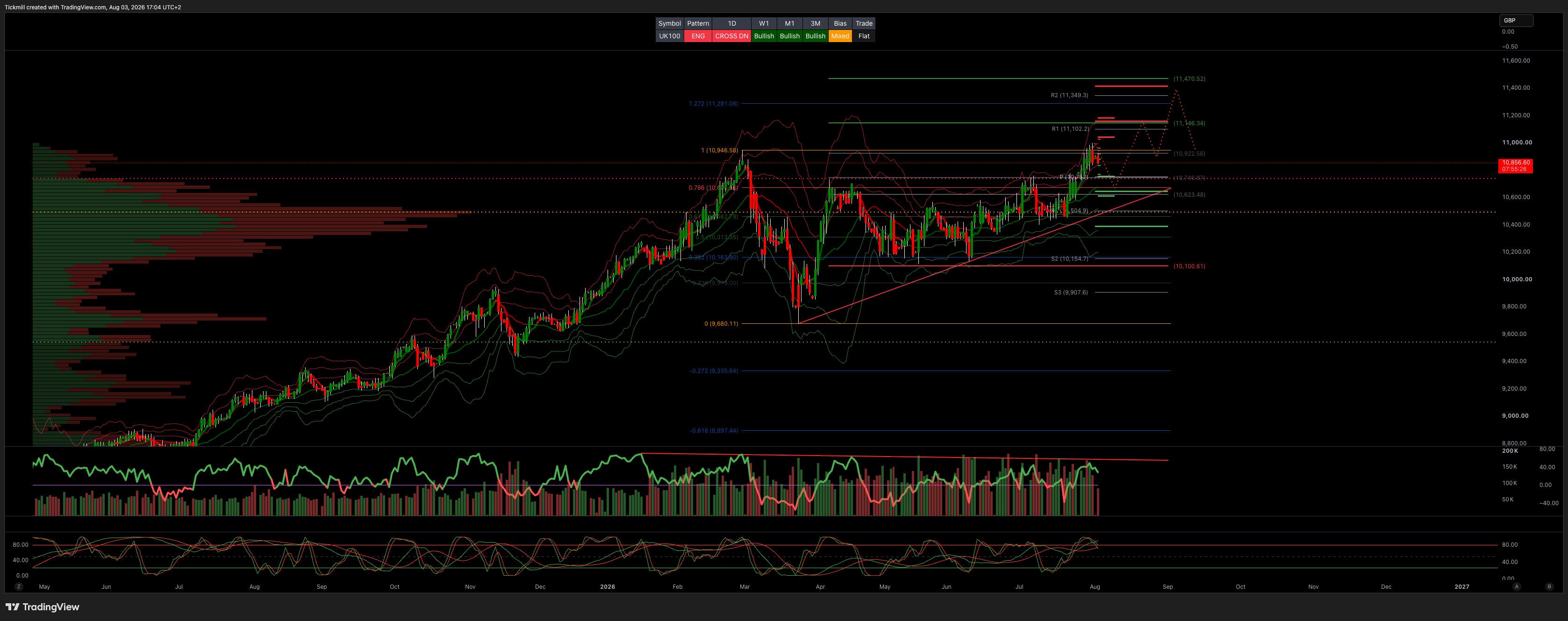
TECHNICAL & TRADE VIEW – FTSE100
Daily VWAP Bullish
Weekly VWAP Bullish
Above 10700 Target 11150
Below 10400 Target 9500
Disclaimer: The material provided is for information purposes only and should not be considered as investment advice. The views, information, or opinions expressed in the text belong solely to the author, and not to the author’s employer, organization, committee or other group or individual or company.
Past performance is not indicative of future results.
High Risk Warning: CFDs are complex instruments and come with a high risk of losing money rapidly due to leverage. 69% and 73% of retail investor accounts lose money when trading CFDs with Tickmill UK Ltd and Tickmill Europe Ltd respectively. You should consider whether you understand how CFDs work and whether you can afford to take the high risk of losing your money.
Futures and Options: Trading futures and options on margin carries a high degree of risk and may result in losses exceeding your initial investment. These products are not suitable for all investors. Ensure you fully understand the risks and take appropriate care to manage your risk.
Patrick has been involved in the financial markets for well over a decade as a self-educated professional trader and money manager. Flitting between the roles of market commentator, analyst and mentor, Patrick has improved the technical skills and psychological stance of literally hundreds of traders – coaching them to become savvy market operators!